

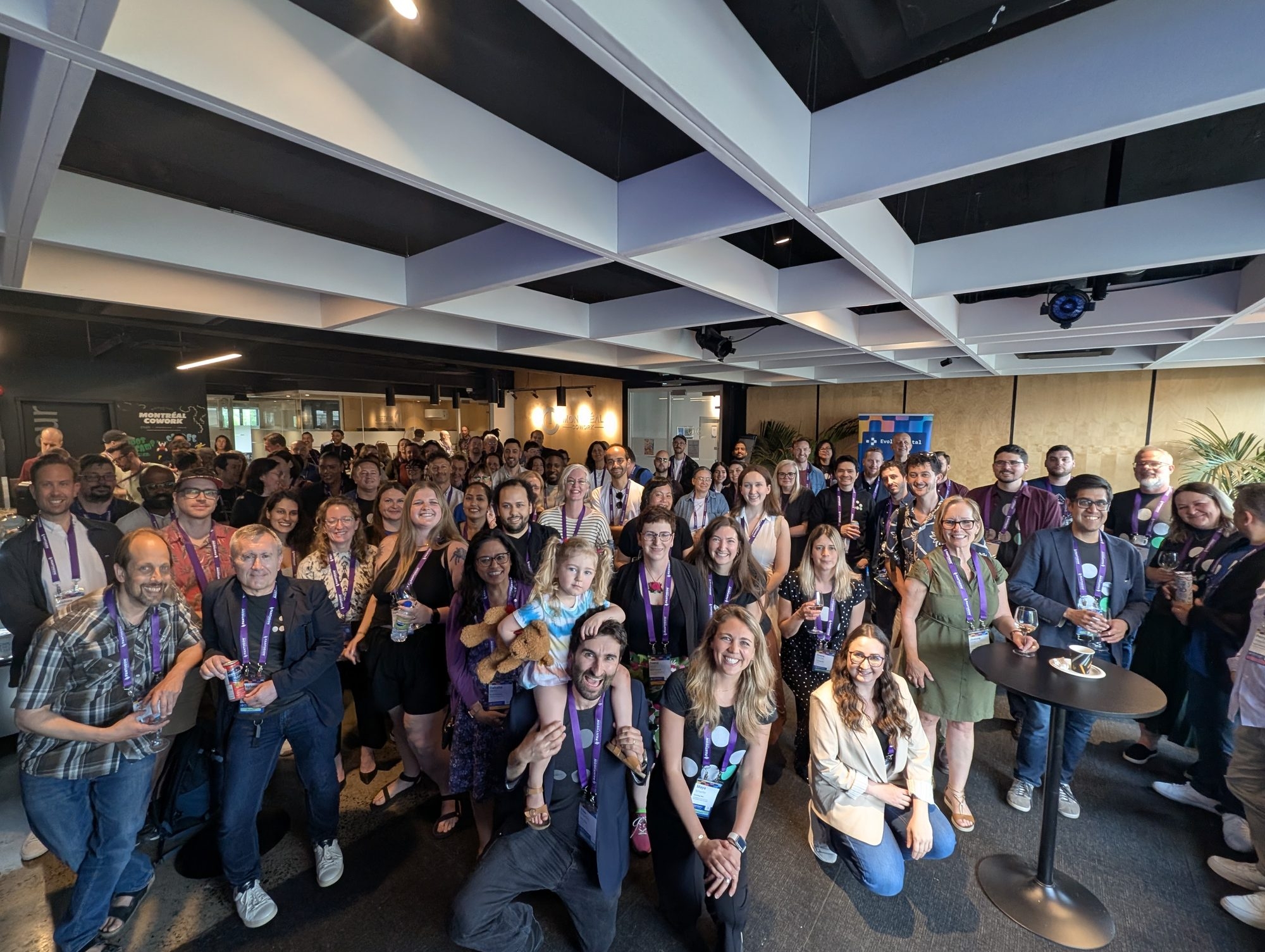
EvolveDigital Montréal 2026 brought together people working across digital strategy, marketing, design, development, accessibility, higher education, and AI.
A lot of the day focused on AI, but the most useful talks were not really about the tools themselves. They were about the work that has to happen around them: cleaning up content, documenting decisions, setting standards, keeping humans in the loop, and helping teams actually change how they work.
Here are a few themes that stood out.
Because EvolveDigital Montréal was a bilingual summit, some session recordings are in French. For English subtitles, click the YouTube settings icon, turn on captions, and choose auto-translate to English.
1. AI is making messy content harder to ignore
One of the clearest examples came from Joyce Peralta’s talk on McGill University’s unified content model. McGill has a very large web ecosystem, with many sites, many contributors, and many ways of describing the same things. Joyce shared the example of dozens of different terms being used for “program components.” That kind of inconsistency is confusing for users, but it also becomes a problem for AI. If the content does not use consistent concepts and relationships, AI tools have a harder time producing useful answers.
The point was not “let’s use AI to fix content.” It was the opposite: if you want AI to work well, you need to fix the content model first.
Roland Benedetti’s talk on content operations made a related point: the CMS is only one part of the content lifecycle. Strategy, drafting, review, branding, legal, localization, publishing, and archiving often happen across different tools and teams. AI can help, but only if teams understand the full workflow and where the handoffs are slowing things down.
At Concordia University, Andrei Kalamkarov shared a related example from inside a web team. His team uses Obsidian as a local project memory, with documentation, standards, and AI workflows written in markdown. The goal is to give the team and their AI tools better context to work from.
Sessions to watch:
Building a unified content model with Joyce Peralta, Digital Communications Manager at McGill University
Leading a team using AI with Andrei Kalamkarov, Web Evolution Manager at Concordia University
Content Ops : maîtriser l'IA pour booster la productivité sans perdre le contrôle with Roland Benedetti, Senior Director of Product Management at Pantheon
2. “Using AI” is not the same as changing how work gets done
The marketing and communications panel gave a good look at what AI adoption actually looks like inside organizations.
The panelists talked about using Copilot, Claude, ChatGPT, NotebookLM, and internal tools for things like drafting, research, media analysis, reporting, and customer insight. But the most interesting part was not the tool list. It was the process around it.
They talked about internal buy-in, compliance, confidentiality, experimentation, and the awkwardness of people not always wanting to admit they are using AI. They also talked about finding internal ambassadors: people who are curious, willing to test, and able to bring others along.
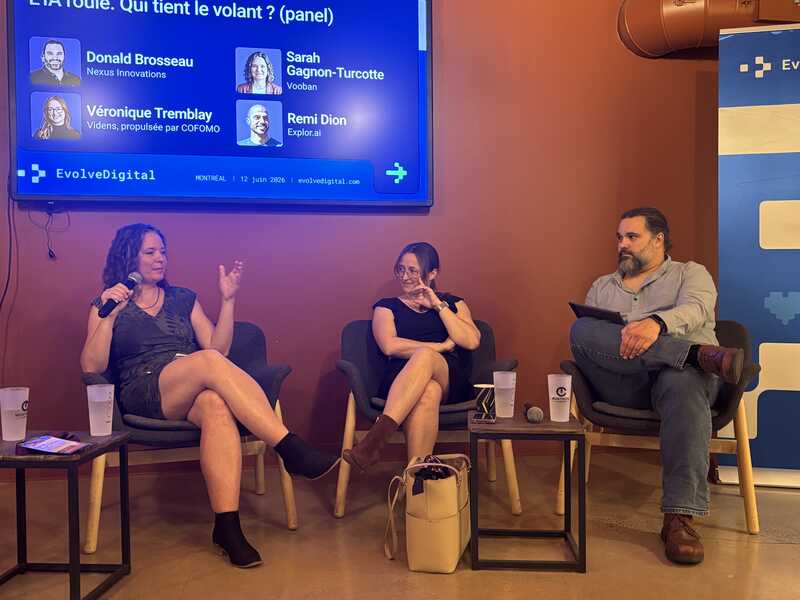
This connected well with the "L’IA roule. Qui tient le volant?" panel, which looked more directly at responsibility, governance, and who gets to steer AI adoption inside organizations.
At Concordia, Andrei shared how AI helped designers and analysts move beyond handoffs and take on more of the build process themselves. That only worked because the team had standards, review processes, and documentation in place.
So the useful question is not “what AI tool should we use?” It is: “what part of our workflow are we actually trying to improve, and what needs to change around it?”
Sessions to watch:
Panel: IA en marketing et communication : que font les leaders en 2026 ? with Amandine Michaud, Aria Consulting; Samira Durand, BC ASSUR; Philippe Orfali, La Caisse & Angela Rodriguez, FinDev Canada
Beyond the prompt: How design process is actually changing with Tif Flowers, Senior Brand Designer at Shopify & Vuong Tong, Senior UX/UI Designer at Perimetre Marketing
AI between writers and the CMS with Kevin Emond, Senior Content Technology Specialist at TELUS
L'IA roule. Qui tient le volant ? with Donald Brosseau, Nexus Innovations; Véronique Tremblay, Videns propulsée par COFOMO; Sarah Gagnon-Turcotte, Vooban & Rémi Dion, Explor.ai
3. AI content needs a point of view
Alexandre Gravel’s talk on higher education brand voice in the age of AI slop was one of the more practical responses to the flood of generic AI-generated content.
His point was simple: AI often produces the average of what already exists. That is why so much AI-generated writing sounds bland, safe, and interchangeable.
For universities and other institutions, this is a real problem. If everyone is using the same tools to write about similar programs, audiences, and values, everything starts to sound the same.
Chaney Moore’s talk on brand awareness in a zero-click world added another reason this matters. People may not always come to your website first anymore. They may encounter your organization through an AI-generated answer, summary, or citation. That means your content needs to be clear, consistent, and specific enough for AI systems to understand what you do and when to include you.
Alexandre proposed a more structured approach to language: define the organization’s voice, vocabulary, style, and tone before asking AI to write anything. In other words, do not just prompt the tool and hope it sounds like you. Give it a language system to work within.
That connects back to the marketing panel too. AI can help produce content, but people still need to decide what the organization sounds like, what it stands for, and what should never be published without review.
Sessions to watch:
Higher education brand voice in the age of AI slop with Alexandre Gravel, Co-president at EspressoToast
Brand awareness in a zero-click world, with Chaney Moore, Director of Client Success at JAKALA
4. Accessibility is not one person’s job
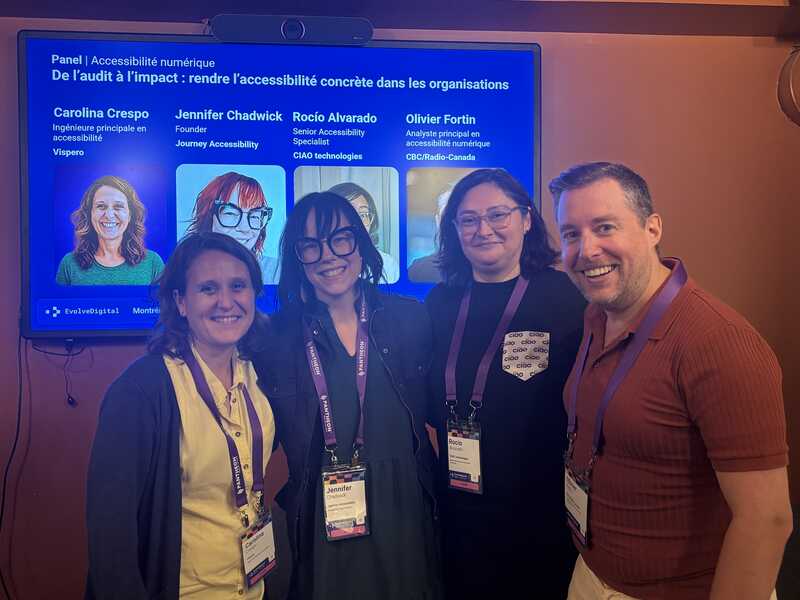
The accessibility panel was a reminder that accessibility only works when responsibility is shared.
The speakers talked about common grey areas: Who writes alt text? Who checks transcripts? Who is responsible when content is added through a CMS? Who makes sure accessibility is included before launch, not after?
The answer was not that everyone should become an accessibility specialist. It was that each role needs to understand its part. Designers, developers, content authors, QA teams, project managers, and leaders all affect whether a digital product is accessible.
The panel also emphasized the limits of compliance-only thinking. Audits, standards, and tools matter, but they are not enough on their own. Teams still need functional testing, lived experience, training, and clear ownership.
Session to watch:
Accessibilité numérique / Digital accessibility with Olivier Fortin, CBC/Radio-Canada; Jennifer Chadwick, Journey Accessibility; Rocío Alvarado, CIAO technologies & Carolina Crespo, Vispero
5. Don’t migrate the mess
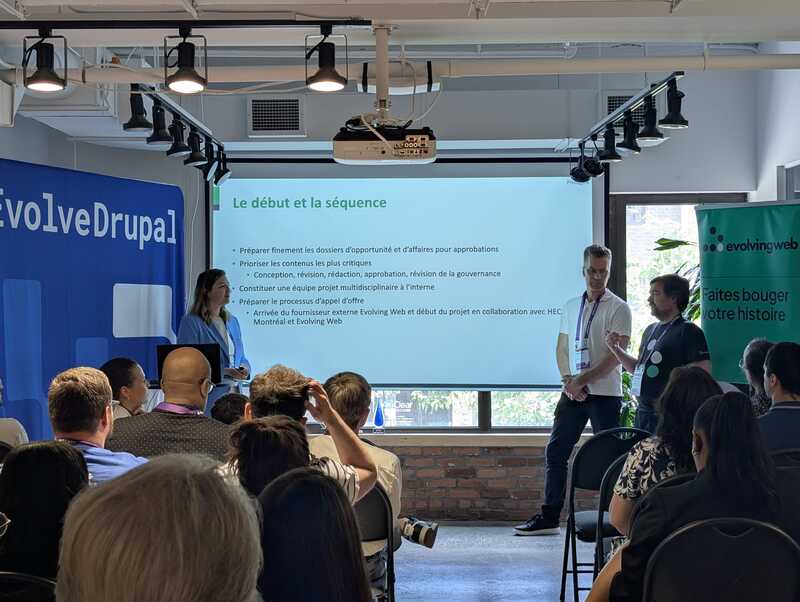
HEC Montréal’s session was a reminder that a CMS migration can either fix old problems or carry them into a new platform.
Rather than trying to move all 10,000 pages at once, the team prioritized critical content like program pages and events for the first launch. They also used a component-based design system to give editors more flexibility without turning every page into a one-off build.
The project was not just technical. A RACI matrix and steering committee helped clarify decisions, especially when different teams had competing priorities. Training and a simpler editing experience also helped reduce reliance on developers for routine content updates.
The takeaway: a new CMS will not automatically make a site easier to manage. You need to decide what gets standardized, what stays flexible, who makes decisions, and how editors will be supported after launch.
Sessions to watch:
Migration, refonte, adoption : simplifier aujourd'hui, faire évoluer demain, Alexandra Claveau, HEC Montréal; Vincent Demers, HEC Montréal & Sébastien Lemieux, Evolving Web
6. Faster is not always better
Marion-Isabelle Muszynski’s talk on robustness stood out because it questioned something digital teams hear all the time: make it faster, leaner, more efficient.
Her argument was that systems optimized only for efficiency can become fragile. If there is no backup path, no extra capacity, no shared knowledge, and no room for change, the system may work well under perfect conditions but fail when something unexpected happens.
She used service design to talk about building more robust systems: ones with multiple paths, stronger relationships, better cooperation, and enough flexibility to keep working when things change.
That idea connected with many other sessions. A content model helps an institution adapt. A project memory helps a team avoid losing knowledge. Accessibility practices need to survive beyond one launch. Platform work needs to support future change, not just the next release.
The BAnQ numérique session offered another version of the same idea. Their team talked about moving away from a “deliver everything at once” mindset and toward a more progressive approach, starting with a solid foundation that could evolve over time. For a public platform with millions of digitized documents, long-term durability and relevance mattered more than adding polish or new features right away.
Sessions to watch:
Designing robustness: service design as a factory of lasting connections with Marion-Isabelle Muszynski, Vice-President of Experience and Service Design at CGI
Refondre le site patrimonial BAnQ numérique avec Drupal: améliorer sans rompre, Claudia Beaumont, Éric Ethier & Charles Martin, BAnQ
Conclusion
EvolveDigital Montréal 2026 made one thing clear: strong digital work is built on the work that happens behind the scenes. Structuring content for AI, clarifying accessibility ownership, simplifying CMS architecture, and documenting decisions may not always be the most visible parts of a project, but they are what help teams scale, adapt, and build better digital experiences over time.
Explore topics like this at our upcoming summits. Visit evolvedigital.com to learn more.

