

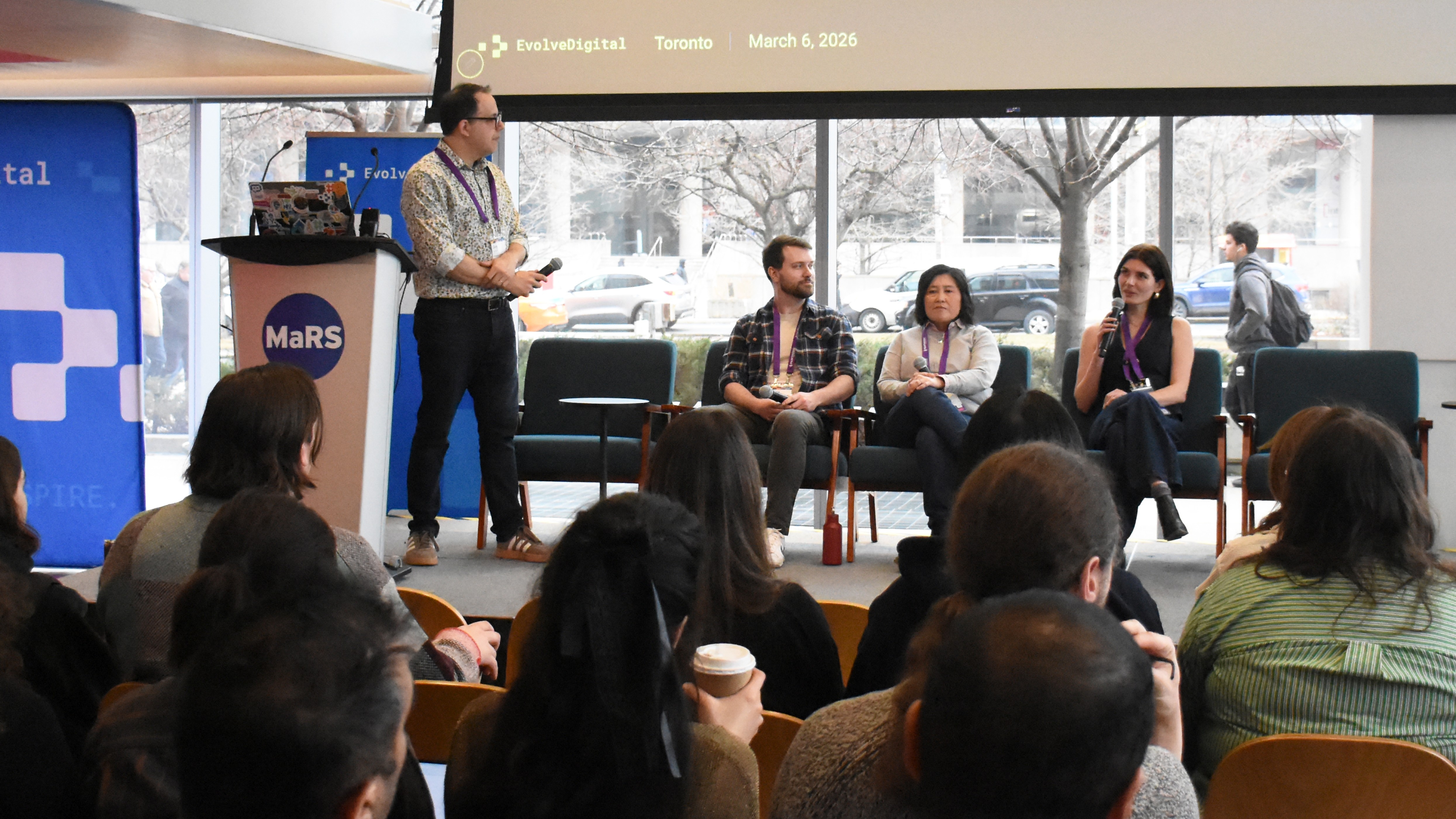
EvolveDigital Toronto 2026 marked our 11th EvolveDigital conference and our third time bringing the event to Toronto. As always, what stood out were the people. Designers, developers, strategists, and digital leaders sharing what’s actually working, what isn’t, and what they’re figuring out next. From opening remarks to hallway conversations, there was a strong sense of collaboration and curiosity that carried through the entire event.
Here are some of the key insights that came out of EvolveDigital Toronto 2026.
Your website’s role is fundamentally changing
Several sessions pointed to a significant shift in how websites work in an AI-driven landscape. AI-powered search and discovery tools are reshaping user journeys. By the time users visit a website, they have often already compared options and formed opinions about your brand and what you offer. The new job of the website is less about persuasion or reputation-building and more about validation.
At the same time, websites must also serve machine audiences. Structured data, semantic markup, and API-accessible content are becoming essential if you want to show up in AI-driven experiences. Organizations must design for both humans and automated systems, balancing usability with machine readability.
Sessions to watch:
- "The AI-driven DXP: New horizons for marketers" - Martin Anderson-Clutz, Acquia
- "Achieving brand visibility in the era of AI-search" - Justin Cook, 9thCO
- "Bringing AI to the website: Digital assistants and personalization" - Nicole Rogers, ai12z
- "The unified estate: Orchestrating design, data, and strategy at Empire Life" - Luke Woolliscroft, Empire Life
Governance enables scale: systems and standards as force multipliers
A consistent theme was the increasingly important role of governance. Organizations that have invested in clear standards, shared practices, and decision-making structures are able to move faster and adapt more easily to change. Rather than acting as bureaucracy, governance functions as the infrastructure that makes work reusable and scalable.
Examples ranged from federated design system models to internal training programs and cross-functional steering committees. These approaches distribute ownership and help avoid common pitfalls such as unclear accountability or neglected website content. In environments without governance, teams often struggle with content duplication and inconsistency, and a lack of control over brand and user experience.
The takeaway is clear, if not always easy to follow: governance is not overhead. It is a prerequisite for scaling digital operations, especially in multisite environments.
Sessions to watch:
- "Stop letting WordPress break your design system" - Dmitry Mayorov, Fueled
- "Consistency at scale in higher education" - Joyce Peralta, McGill University
- "The stakeholder maze: Collaboration lessons from higher education digital projects" - Ian Barcarse and Nicole Woodall, Sheridan College; Jessie Johnston, Evolving Web

Design systems are relationships, not component libraries
Multiple sessions challenged the idea that design systems are primarily collections of components. Instead, speakers described design systems as ongoing relationships between design and development teams, relationships that need continuous maintenance.
This framing shifts the focus from outputs to interactions. A component library may exist, but its success depends on whether teams align on how and when to use it, how decisions are made on updates and standards, and how the system evolves over time. Without that shared understanding, even the most complete library will fail to gain adoption.
By treating design systems as relationship infrastructure rather than static assets, organizations can create systems that are more resilient, more widely adopted, and better aligned with real-world workflows.
Sessions to watch:
- "The design system mindset: Principles, patterns, and real-world lessons" - Design systems panel
Panel members: David Cox, Lyft; Andrea Ong, RBC; Irina Stoica, Bell; Guy Segal, Thomson Reuters - "Five types of landing pages your website needs" - Suzanne Dergacheva, Evolving Web
- "Loblaw Digital’s federated design system: Practical advice for building a system without a team" - James Harrison, Loblaw Digital
- "Setting the tone: Building a shared vocabulary in design" - Chris Mantil, Chris Mantil Design
Accessibility, AI, and the business case for inclusion
Accessibility emerged as one of the most practical and strategically grounded themes at EvolveDigital Toronto. In our panel featuring accessibility specialists from Rogers, CBC, and accessibility consulting firms, a clear pattern emerged: framing accessibility as a compliance requirement or moral obligation is not enough to secure sustained leadership buy-in. Instead, the most effective teams position accessibility as a business imperative: one that reduces risk, protects revenue, and improves product quality.
Speakers emphasized that retroactive remediation is significantly more expensive than building accessibly from the start, making accessibility a cost-avoidance strategy as much as an ethical one. At the same time, accessible products reach broader audiences and tend to have fewer bugs, which translates into faster delivery and improved user experience. This reframing shifts accessibility from a compliance function into a contributor to business performance.
AI is accelerating this shift, but it is not the primary driver. Tools that generate alt text, captions, and accessibility checks can help teams produce measurable outputs that leadership can track. For example, CBC demonstrated cases where AI-generated alt text outperformed human-written descriptions across a sample set. However, current AI testing tools still identify only a fraction of accessibility issues, reinforcing the need for human validation, especially from people with lived experience.
Ultimately, accessibility succeeds when it is positioned as a strategic investment. AI strengthens the case, but the real lever is how the work is valued and prioritized.
Sessions to watch:
- "Accessibility unlocked: People, tools, and what's next" - Accessibility panel
Panel members: Juan Olarte, Digita11y Accessible/A11YVERSE; Pina D'Intino, Aequum Global Access; Niki Ramesh, CBC; Jeevan Bains, Rogers Communications; Fran Wyllie, Northern

AI works best on the boring stuff
Despite the prominence of generative AI in industry conversations, the most successful implementations discussed at the conference were not the most visible or creative ones. Instead, it seems that AI adoption is highest in areas where it reduces friction in repetitive, time-consuming tasks.
Use cases such as content translation, Search Engine Optimization (SEO) metadata generation, accessibility support, and email formatting consistently delivered measurable results. These tasks share a common characteristic: they are tedious, clearly-defined, and easy to evaluate. As a result, they are well-suited to AI and face little resistance from teams.
Examples included the University of Toronto reducing email production time significantly through automation, developers saving time on repetitive coding tasks, and chatbots handling high volumes of routine inquiries. In each case, the value of AI was not in replacing creative work but in removing operational bottlenecks.
The implication is that organizations should start with practical, low-risk applications of AI. Building confidence through these use cases creates a foundation for more ambitious initiatives later.
Sessions to watch:
- "The future of WebOps: How AI and changing tech up the ante" - Kevin Basarab, Pantheon
- "600 sites 8 years outdated: A massive multisite WordPress upgrade" - Jesse Dyck, Evolving Web
AI adoption is change management, not technology implementation
Another recurring insight was that AI adoption is primarily an organizational challenge rather than a technical one. Across sectors, the most significant barriers were not related to tools or platforms but to people, processes, and institutional dynamics.
Successful teams focus on identifying real problems before introducing AI solutions, engaging stakeholders early, and building trust through incremental implementation. Frameworks shared at the conference emphasized phases such as planning, engagement, enablement, and scaling, each centred on human factors rather than technical complexity.
This approach recognizes that resistance to AI often stems from uncertainty, lack of clarity, or competing priorities. Addressing these issues is essential for adoption to succeed.
Sessions to watch:
- "AI in practice, not theory" - Emma Nguyen and Gary Bhanot, University of Toronto
- "Choose your own AI adventure" - Brian Piper, AIreFlow Solutions
AI is reshaping the technical landscape: APIs, structured content, and composability
Beyond specific use cases, several sessions pointed to a deeper shift in the technical foundations of digital platforms. As AI becomes a primary interface for discovery and interaction, the way content is structured and delivered is changing.
Speakers emphasized that APIs are becoming as important as front-end experiences. Content is no longer created solely for human consumption, it must also be accessible to AI systems that retrieve, interpret, and recombine it. This requires organizations to move toward structured, machine-readable formats such as JSON, schema markup, and well-defined content models.
This shift has architectural implications. Composable, API-first systems are better positioned to support AI integrations, while tightly coupled or monolithic platforms introduce friction. Andrew Kumar reinforced this point with data showing that organizations with API-first architectures are adopting AI more quickly and effectively than those with legacy systems.
Emerging standards such as the Model Context Protocol (MCP) further signal where the ecosystem is heading. While still evolving, they point toward a future where systems communicate directly with one another, and where content and services must be exposed programmatically.
For teams, the takeaway is clear: structured content and APIs are no longer optional; they are foundational to AI readiness.
Sessions to watch:
- "AI that actually matters in 2026" - Andrew Kumar, Uniform
- "How to make AI work for everyone with visual headless CMS" - Preston So, React Bricks
Why human oversight remains essential
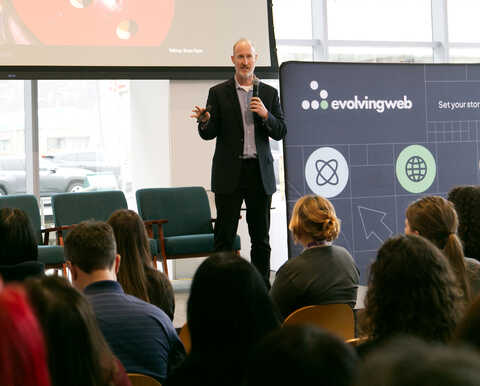
Across EvolveDigital Toronto, one of the most consistent themes was that human oversight remains non-negotiable in AI workflows. Speakers repeatedly emphasized that while AI can accelerate production, it cannot be trusted to operate independently in contexts that affect users, content quality, or business outcomes. Frameworks like Brian Piper’s “human-in-the-loop” model and Preston So’s emphasis on structured, bounded systems reinforced the same point: humans must define context, validate outputs, and remain accountable for results.
Charlotte Miller and Leanne Ruiz at McMaster University showed what this looks like in practice. During their six-month generative AI chatbot pilot, the team ran weekly review cycles: monitoring unanswered questions, identifying content gaps, editing source website copy, and measuring accuracy. They tracked both quantitative signals (thumbs-up/thumbs-down ratings, escalation rates) and qualitative feedback from staff and students. The result was a system that improved continuously because humans stayed actively engaged in the feedback loop, not passively relying on the technology.
Sessions to watch:
- "From questions to clarity: Using AI to transform student service" - Charlotte Miller and Leanne Ruiz, McMaster University
- "Beyond the website: Preparing your content, your team, and your strategy for the future of discoverability" - Brian Piper, AIreFlow Solutions
Human skills matter more, not less
As AI takes on more production tasks, human skills are becoming even more valuable.
As AI increases content volume, the real constraint is attention, making clear, well-structured communication more important than ever. Sessions across disciplines emphasized the importance of user research, strategic thinking, and communication, capabilities that cannot be easily automated. For example, Adie Margineanu showed how even light user research can drive measurable gains in conversion and search performance while reducing risk by grounding decisions in real user behaviour.
AI-generated outputs without human context were frequently described as generic and indistinguishable. What differentiates organizations is not their ability to generate content, but their ability to ground that content in real insight and experience. Anton Morrison showed us how AI can compress the work of entire teams into a single workflow, but also highlighted that this kind of output depends on well-designed systems, context, and human oversight.
This includes incorporating lived experience into accessibility work, translating complex ideas across teams, and making informed strategic decisions. These are areas where human judgment remains essential.
Sessions to watch:
- "AI page building in Drupal Canvas" - Aidan Foster, Foster Interactive
- "Do people still read emails? Yes. Just not how you think." - Dayana Kibilds, Ologie
- "Creating impact while mitigating risk: The strategic value of user research" - Adie Margineanu, University of Toronto Scarborough
- "Building a second brain in Claude Code" - Anton Morrison, Mogul
- "Focus on the signals to cut through the noise" - Sean Stanleigh, The Globe and Mail
Conclusion
EvolveDigital Toronto 2026 highlighted several key takeaways: accessibility as a business strategy, governance as a foundation for scale, AI adoption grounded in real problems, and the continued importance of human oversight. As the digital landscape continues to evolve, the organizations that focus on these fundamentals will be best positioned to adapt.
Get in touch to discuss adapting your digital strategy to meet the changing landscape.

